How can we promote authentic knowledge acquisition for students in the AI era—especially in research projects? Our latest betterthinkers post introduces the AI to Authentic Knowledge (AAK) Framework.
The AAK Framework helps educators and students balance AI tools with deep, critical thinking. Explore strategies for fostering meaningful knowledge acquisition.
Equal Knowledge?
Imagine you are attending an exhibition that showcases student projects on important social issues. As you move from booth to booth, you come across two presentations by Student A and Student B. Both address the same topic, answer similar questions, and present the same key facts. Both students speak with confidence, leaving you impressed and informed.
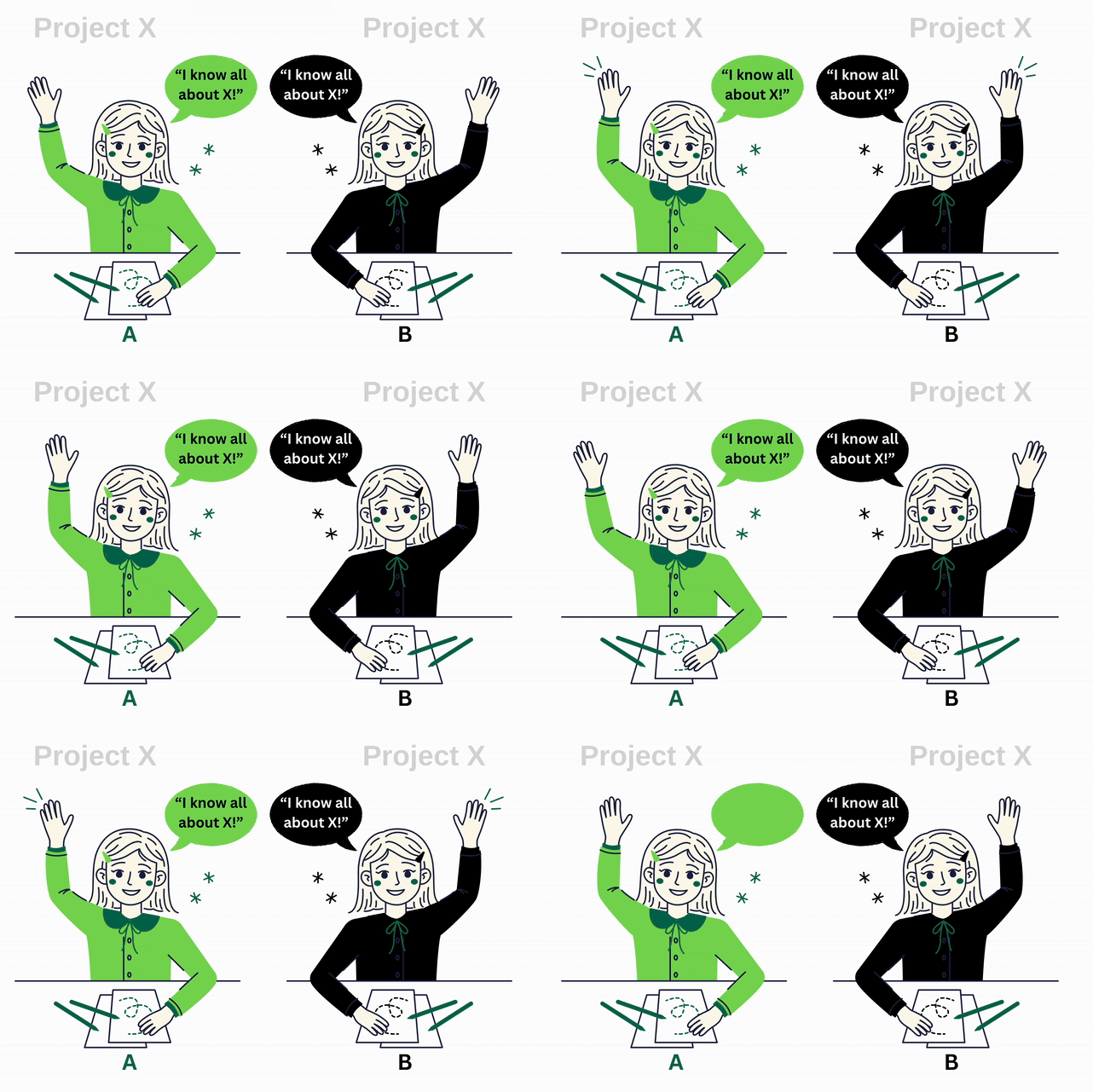
Later, their teacher reveals a key difference:
- Student A synthesized their research by reading, analyzing, and taking notes, gradually building their understanding over time.
- Student B used ChatGPT to generate a summary of the same research but never read the sources directly. Instead, they memorized the AI-generated synthesis a few days before the exhibition.
Now, ask yourself: Who truly has knowledge in this case? Does your intuition tell you that both students’ understanding is equally authentic?
This Equal Knowledge thought experiment raises a key issue in education today: To what extent do students really, truly own the knowledge they convey to others? In this post, I explore this question and the implications that the Equal Knowledge thought experiment poses in regards to students’ cognitive development and how we might avoid them. Recognizing that AI will inevitably be part of our learning environments, I propose what I call the AI to Authentic Knowledge Framework or AAK Framework that can be applied to research projects that both preserves students’ cognitive growth and fosters authentic, heartfelt learning.
The Importance of Knowledge Acquisition Over Time
I see knowledge acquisition as both a mental process (thinking, learning, remembering, and understanding) and a social process (constructing shared knowledge through discussion, debate, and collaboration). In both cases, a level of care and concern shapes how knowledge1 is developed over time.
This notion of knowledge acquisition became especially relevant in my Grade 5 class when students asked me: “Can we use ChatGPT?” as we began our PYP exhibition (PYPx) research projects.2
My instinctive answer was a reluctant no. Not because AI should be ignored, (it’s here to stay), but because if the purpose of school is to develop thinking and language (at least this is my stance), then the process of knowledge construction matters just as much as the final product. The act of grappling with ideas, constructing understanding bit by bit, is what makes learning deeply personal.
This is the unease I feel in the Equal Knowledge thought experiment: AI-generated summaries remove the struggle, the care, and the ownership that make learning or knowledge acquisition authentic and meaningful. In taking the time to pursue our understanding of an issue we truly care about, we tend to identify with it more as we embed it deeply into the fiber of our being.
Additionally, in inquiry-based classrooms where we promote a feel-think-act model, We are facing a paradox: Although we encourage students to slow down and deeply engage with an issue in order to inform action, an action can take place much quicker if we let AI do the thinking for the students.3 And if a student feels compelled to act quickly, because to act is to care, then why not let AI do the arduous work of analyzing how one ought to act?
The dilemma here is that AI allows students to take action on an issue more quickly, but without fully understanding what led them to that action. The critical and creative thinking many educators champion as essential “21st-century skills” is diminished when AI does the heavy cognitive lifting that students should be doing themselves.
If we believe knowledge should intertwine thinking and feeling, then AI, despite its capabilities, cannot replicate the depth of engagement we hope students will develop. Therefore, as we integrate AI into researching or learning, we must recognize two potential long-term costs:
- Diminished Cognitive Struggle – When AI handles the hard thinking, students miss out on the developmental benefits of grappling with ideas.
- Absence of the Heart – Fast-tracked research removes the personal connection and care that make learning meaningful.
However, not all is lost if the purpose of secondary research is to help students grasp broad concepts before applying them with a local lens. We can take the approach that AI-generated summaries are useful—but only when paired with primary research and deep engagement.
A Framework for AI in Knowledge Acquisition
To balance AI’s efficiency with authentic learning and research, I propose the AI to Authentic Knowledge (AAK) Framework, which allows AI to serve as a tool for structuring inquiry rather than replacing thinking.
The AAK Framework:
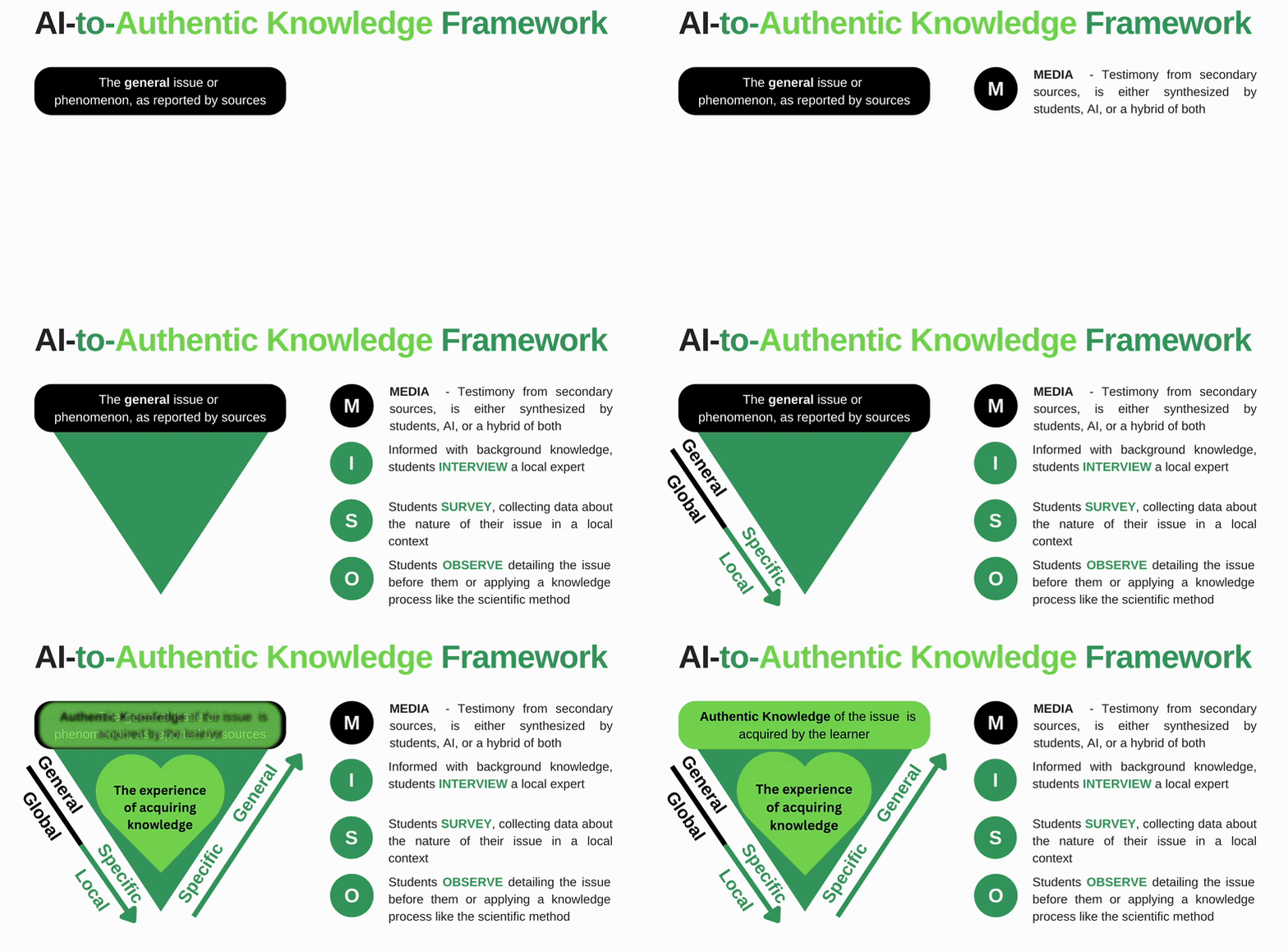
Here are the basic steps:
- Use AI for Broad Understanding4 – AI can synthesize key issues from secondary Media sources to provide a starting point. e.g., What are the key features of climate change? How does it affect society?
- Primary Research – Students then conduct interviews, surveys, and observations to refine their understanding on the same topic but in a more local context. e.g. What does climate change look like in Malawi? How does climate change affect Malawians?
- Engage in Iterative Thinking – Students return to general AI-generated insights , critically analyze them, and refine their perspectives through direct engagement with primary data from their interviews, surveys, and observations.
When the research project is complete, the student acquires…
💚 Authentic Knowledge
Note that the structure of knowledge in this framework is one where it starts at a general level and then moves to a more specific or local level where the student conducts their primary research. This is a deductive reasoning process. But as they round out their research, they take their primary data back to inform the understanding of the general issue. This is an inductive reasoning process.5
The importance of this structure for learning in general is extremely important for both the mental and social process of knowledge acquisition as it prioritizes a perspectival view of knowledge from both the individual and the community levels as opposed to whatever bank of data the original AI-generated synthesis was developed. The upshot is authentic knowledge, knowledge that is produced, verified, and supported from a local perspective.
Conclusion
My ultimate aim with the AAK Framework is to ease the discomfort we feel when questioning whether students truly know or are merely reciting information to appease the expectations of schooling. If presenting knowledge lacks genuine engagement, learning opportunities risk becoming performative tasks.
By positioning AI as an enhancer of inquiry rather than a substitute for thinking, we help students develop the intellectual habits necessary for authentic knowledge acquisition. AI should not replace the struggle of learning but support deeper exploration.
In a world where AI generates instant answers, our responsibility is to ensure students still engage critically, wrestle with ideas, and connect to knowledge in a meaningful and authentic way. By blending AI’s efficiency with primary research and iterative thinking, we preserve the integrity of learning to ensure that knowledge is not just acquired, but truly owned.6
Stay epistemically well,
Jamie @betterthinkers
Footnotes:
- For simplification, I use knowledge as an all encompassing term for understanding, conceptual understanding, or basically anything that is related to knowledge. ↩︎
- The PYPx is the culminating project in the International Baccalaureate (IB) Primary Years Programme (PYP) where Grade 5 students to explore an issue they care about through research, critical thinking, and action. ↩︎
- The philosophy of teaching I am in, views learning as most impactful when it allows the student to act on what they know. I generally agree with this stance, but prioritize the cultivation of thinking and language development over action. Authentic knowledge leads to authentic action. Superficial knowledge leads to superficial action as a rule of thumb. ↩︎
- AI can be used to assist synthesis, or not at this stage. ↩︎
- Also note that this framework is even more powerful if AI is never apart of the process. And for the record, I am not endorsing AI, I am merely creating a safe and responsible space for it. ↩︎
- Disclosure: I used Chat-GPT to help with iron out some redundancies in previous drafts and to bring my conclusion together. However, I can fully, certifiably regurgitate every nook and cranny of this post. ↩︎

 betterthinkers
Leave a comment