In this post, I share how I guide student understanding of what thinking looks like at various levels of complexity in order to develop their conceptual understanding.
Let’s treat thinking as an action. Kind of like walking. But now consider the different ways we can walk. One can skip, jaunt, stumble, limp, waddle, swagger, meander, etc. Unlike walking, we might not be able to see what thinking looks like. Nonetheless, we have different verbs that relate to thinking. This was a list generated to me by chat gpt-3.5:
- Analyze
- Evaluate
- Reflect
- Consider
- Contemplate
- Ponder
- Ruminate
- Deliberate
- Speculate
- Conceive
- Imagine
- Envision
- Visualize
- Perceive
- Comprehend
- Understand
- Grasp
- Synthesize
- Interpret
- Decipher
- Solve
- Deduce
- Infer
- Conclude
- Assess
- Estimate
- Predict
- Plan
- Decide
- Rationalize
and Chat GPT-3.5 states that, “these verbs encompass a wide range of cognitive activities, from basic thinking processes to more complex reasoning and problem-solving tasks.”
I want my student to think about the different ways we can think. By building a cataloguing verbs that show different ways of thinking, I want students to realize that some of what we do thinking-wise is quite simple and straight forward but others are quite strenuous and complex.
Bloom’s taxonomy categorizes this into hierarchical sets of lower-order or higher-order thinking skills:
Courtesy of Chat GPT-3.5
Remembering (Knowledge):
- Recognize
- Recall
- List
- Define
- Identify
- Memorize
- Label
- Name
Understanding (Comprehension):
- Explain
- Summarize
- Describe
- Paraphrase
- Interpret
- Compare
- Contrast
- Discuss
Applying (Application):
- Apply
- Demonstrate
- Use
- Implement
- Solve
- Illustrate
- Construct
- Operate
Analyzing (Analysis):
- Analyze
- Compare
- Contrast
- Differentiate
- Break down
- Investigate
- Examine
- Classify
Evaluating (Evaluation):
- Evaluate
- Judge
- Critique
- Assess
- Justify
- Prioritize
- Recommend
- Defend
Creating (Synthesis):
- Create
- Design
- Invent
- Generate
- Construct
- Combine
- Formulate
- Develop
What’s important is that not only should we generate verbs with students and try to categorize them, but they should also engage in drawing, symbolizing, and acting out these verbs give students a sense of what each verb looks like, either metaphorically or analogically.


Bloom’s is just a reference for the teacher: What is most important is that the Bloom’s stuff should be your reference as a teacher as you sort and categorize the verbs generated by the students with the students.
Which verbs seem like simple, easy or quick thinking tasks? Which verbs seem to be verbs that require more challenging ways of thinking? Once you have this sorted with students you have a framework to build levels of conceptual understanding.
Here are some examples from my classroom
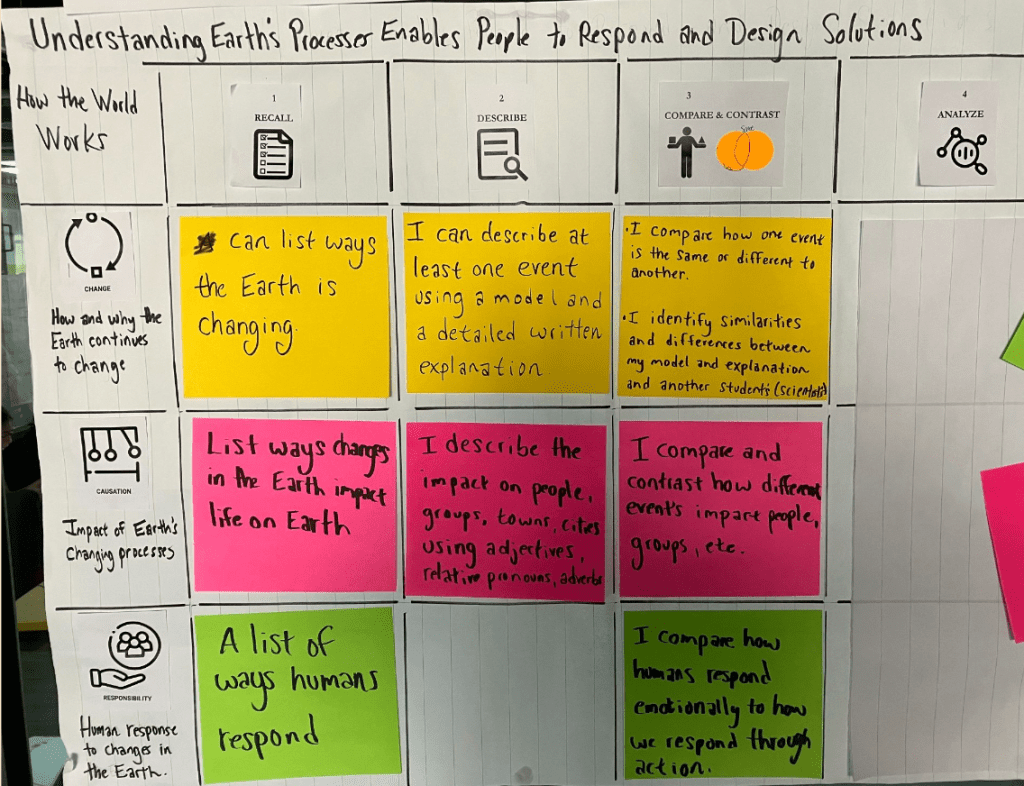
Examples of thinking and understanding centered around thinking verbs

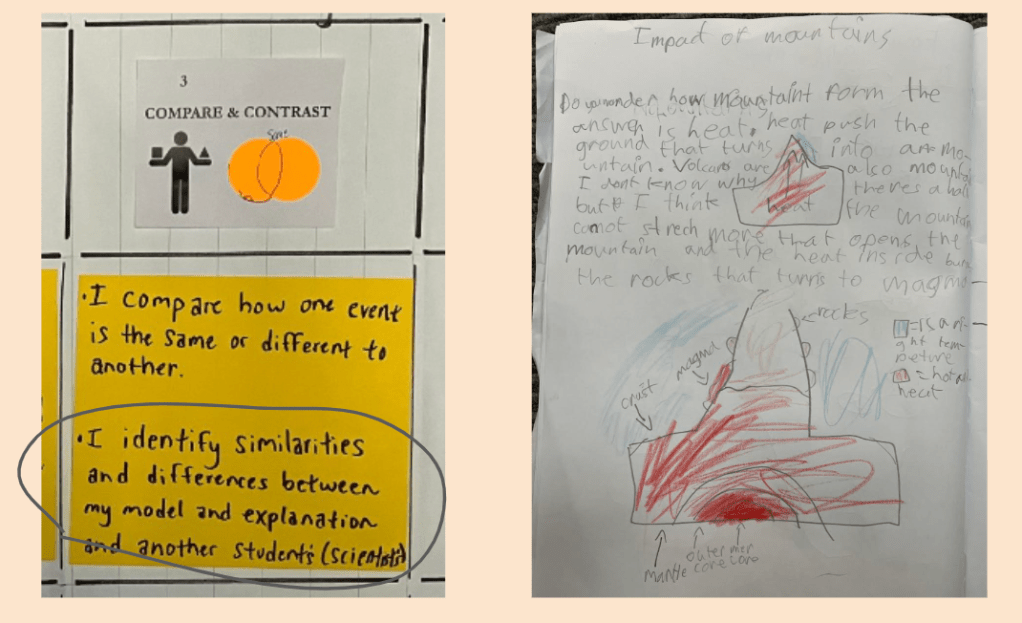
The big benefit of this according to Tania Lattanzio of innovativeglobaled.org (much of whose work inspired this scheme) is that students not only gain the capacity to assess or evaluate themselves and peers, but they can also become self-adjusters. Self-adjusters can independently consider what they understand, how they understand it, and what might be next in their quest to understand. Indeed, when I confer with students about their level of understanding, they should be able to take notes from our discussions about where to go next and what the nature of that thinking might look like moving forward. Meanwhile, I consider the conditions needed to facilitate the journey and support their agency.

 betterthinkers
Leave a comment