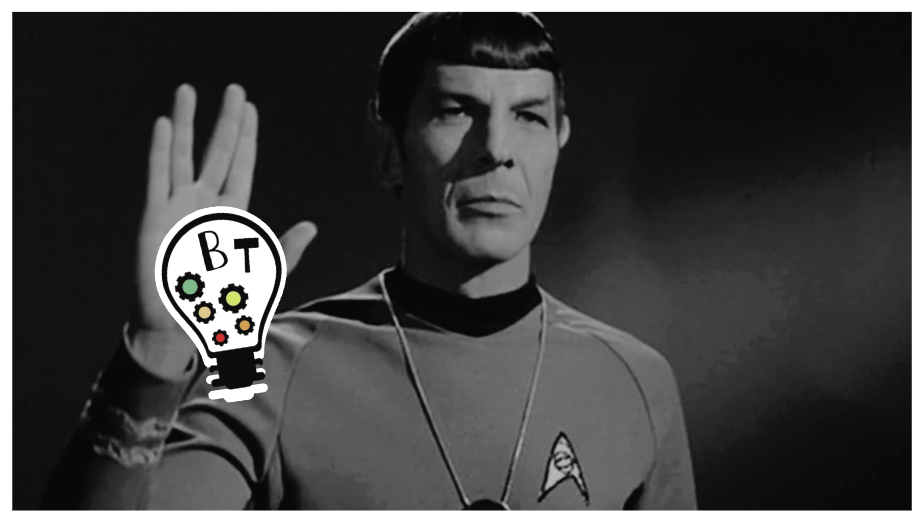
We often teach students that when making a claim, the should support their claim with reasons, examples, evidence. Often these supports take shape of inductive or deductive reasoning.
But what is the difference and why is it important for young people to know the difference?
Inductive Reasoning is when you build up support to strengthen a claim. However, it can only be a strong claim or argument, not necessarily true. Here is an example:
John the Trekkie 1
- John wears a Star Trek pin on his shirt about once a week.
- He has been seen giving the the Vulcan salutation on occasion.
- He often doodles on his writing books images of the Starship Enterprise during class.
- Claim – John is a Trekkie, a fan of the show Star Trek.

(Image: https://trekmovie.com/wp-content/uploads/2020/06/vulcansalute-head-777×437.jpg)
In assessing this claim, it seems to be a strong claim that John is a trekkie or a big fan of Star Trek. But to what degree can we be sure? What if we add another piece of evidence that could have adverse effect on our claim?
John the Trekkie 2
- John wears a Star Trek pin on his shirt about once a week.
- He has been seen giving the the Vulcan salutation on occasion
- He often doodles on his writing books images of the Starship Enterprise during class
- He and his friends (none of which seem show any interest in Star Trek) go to conventions to beat up trekkies.
- Claim – John is a trekkie, a fan of the show Star Trek.
Now that we have more evidence, is the previous claim that John is a trekkie as strong? What other claims could one have?
John the Trekkie 3
- John admits that he shows interest in Star Trek just to make fun and pick on other trekkies.
- He and his friends (none of which seem show any interest in Star Trek) go to conventions to beat up trekkies.
- Counter Claim: John is not a trekkie and is not a fan of the show Start Trek.
The more evidence you have one way or another claim vs. counter-claim will strengthen the argument either way.
The we can do when inductive reasoning is build case for our claim to make it as strong as possible.
Science often involves inductive reasoning. If I see 50 instances of something happening the same way, I can make a claim that the next instance will happen the same way or generally speaking, this is what happens every time based on my view of past instances.
Example:
When I put a pot of water on the stove, I will notice on my thermometer the water begins to boil when at 100 °C. Every time I take this measurement, this is the case. Whether it be 50 times, 100 times…it always boils at 100 °C. I have strong reasoning to the claim that water boils at 100 °C.
But is this always the case? Is this more than just a strong claim? Maybe it is just true every time?
What if you boil that same water at a high elevation, say on top of a mountain? If you live in the Peruvian mining town of La Rinconada, which sits at 16,700 feet above sea level, the water will begin boiling at 83°C1. Our claim that water boils at 100 °C is no longer a strong claim. We have to add other reasons or evidence to explain why the boiling point changes. The elevation changes? The air pressure? The air density? Whatever we infer as reasons, the original claim needs modification.
Much like was written in the Problem of Induction, we use inductive reasoning all the time and it often leads us to strong claims/conclusions we can confidently make further decisions with. However, be mindful that we do not see all circumstance around situations we experience and observe. And when we make a “sure” claim that proves otherwise, be aware of the ultimate claim, that we can never be certain, we can only have strongly reasoned beliefs.
References:
1Pew Research Center, & Desilver, D. (2015, September 15). Does water’s boiling point change with altitude? Americans aren’t sure. Pew Research Center. https://www.pewresearch.org/fact-tank/2015/09/14/does-waters-boiling-point-change-with-altitude-americans-arent-sure/

 betterthinkers

Leave a comment